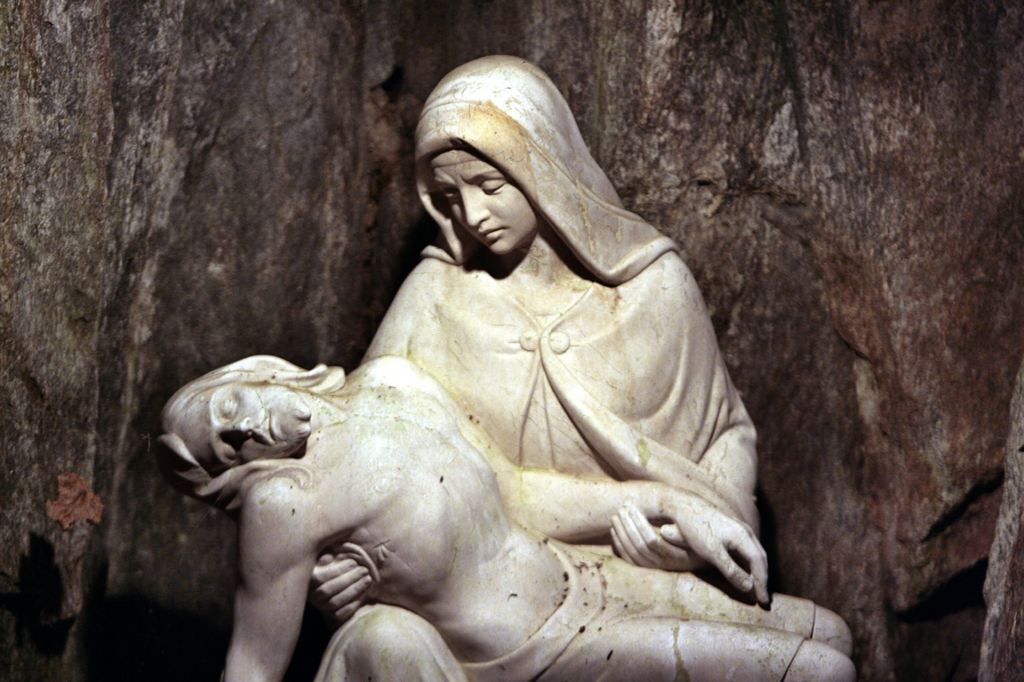
Fern, a neurodivergent Christian with a chronic illness, was longing for a church that would be her refuge.[1] Sadly, she more often found communities that could not imagine a disabled person like her among the Body of Christ. Left feeling “less than human” after her experiences in churches, Fern began to wonder whether she was really made in the image of God.
When Emily Richardson and I were looking for an image for the cover of At the Gates: Disability, Justice and the Churches, we wanted a picture showing that disabled people, too, are made in the image of God. The search led us to Rachel Holdforth’s disabled Christ prints.
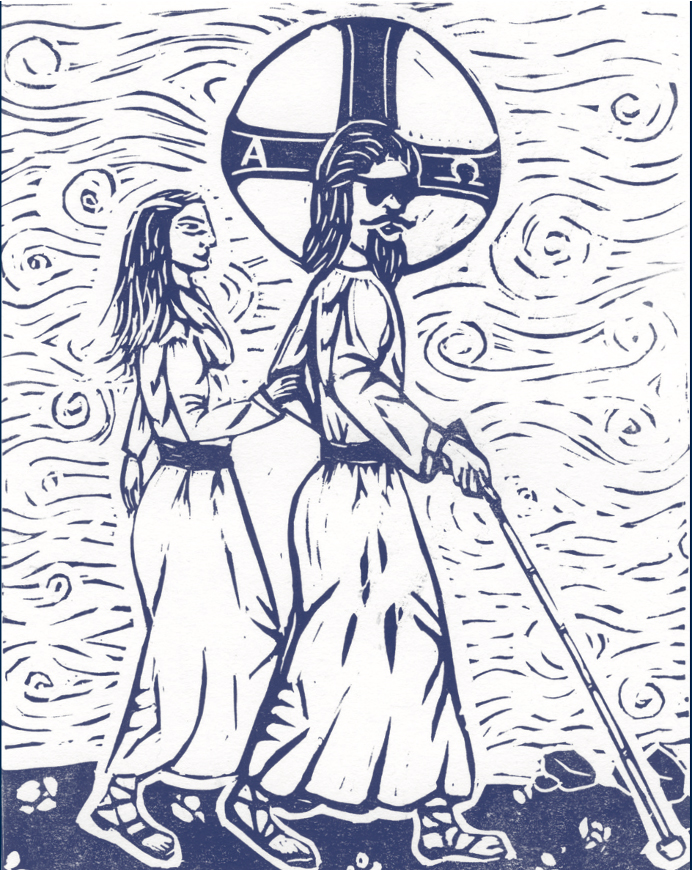
Holdforth’s print of a blind Christ leading a sighted disciple is part of a powerful tradition of diverse iconography, which includes Christas and Black Christ figures. This tradition reminds us that our icons shape our imagination of the imago Dei, telling stories about who belongs among the Body of Christ.[2]
Yet images of a white, male, non-disabled God are much more familiar representations of the divine.[3] We know that Jesus lived in poverty under Roman occupation, with no access to modern healthcare. He and his disciples probably had impairments and almost certainly experienced trauma. But we do not meet this Jesus in most iconography.[4]Those with power and privilege in churches have told most of the stories about a God like them.
Surrounded by images of the divine that do not represent us, it can be hard for disabled people to imagine a God like us. But after her traumatic experiences of exclusion, Fern found healing in a different image of Jesus:
Jesus was disabled too, after the crucifixion…. But we don’t discuss that side of it ever… Maybe [the story is] not just the nice fairy-tale version.
As she saw herself reflected in this Jesus, Fern came to understand that she is loved, valued and created just as she is. She points us to a disabled Christ who is calling churches to repentance for our marginalisation of disabled people:
It makes you wonder if [a disabled Jesus] would find church completely accessible. Would we pray for healing for him – but in doing so, would that erase the whole crucifixion? Would we think it was his fault it had happened? Would it mean we wouldn’t pay attention to what he said or who he was?
Insights from diverse experiences of disability gave our storytellers the courage to imagine God differently. Their expansive imagination of the imago Dei is a gift to the church.[5]
We still see too few images of a Christ who is embodied differently from the norm – or disabled disciples. But as disabled people lead the way in telling different stories about God, the church may finally come to imagine disability as part of the “universality of the God who became fully human.”[6]
About the author:
Naomi Lawson Jacobs is a disabled, neurodivergent social researcher whose participatory research explores the experiences of disabled Christians. Naomi’s book ‘At the Gates: Disability, Justice and the Churches,’ co-written with Emily Richardson, centres disabled Christians’ stories and prophetic calls for justice. Naomi has had many years’ involvement with the Inclusive Church/St Martin-in-the-Fields Church disability conference, and is a member of the CMDDP’s new Neurodiversity Working Group.
[1] Fern’s story and quotations taken from JACOBS, N. L. & RICHARDSON, E. 2022. At the Gates: Disability, Justice and the Churches, London, Darton, Longman and Todd Ltd.
[2] “Our cultural representations attach meanings to bodies.” GARLAND-THOMSON, R. 1997. Extraordinary Bodies: Figuring Disability in American Culture and Literature, New York & Chichester, Columbia University Press. 5.
[3] MCDONALD, C. 2021. God Is Not a White Man, London, Hodder & Stoughton.
[4] BERQUIST, J. L. 2009. Childhood and Age in the Bible. Pastoral Psychology, 58, 521-530.
[5] Only a few of our storytellers had read Nancy Eiesland. Most had heard the story of a wounded Christ from the grassroots – from other disabled people who found the story powerful. EIESLAND, N. L. 1994. The Disabled God: Toward a Liberatory Theology of Disability, Nashville, TN, Abingdon Press.
[6] SPARY, S. 2020. Archbishop of Canterbury says portrayal of Jesus as White should be reconsidered. CNN, 27 June 2020.https://edition.cnn.com/2020/06/27/uk/justin-welby-jesus-scli-intl-gbr/index.html
 Disability Matters
Leave a comment